driveways adelaide people hear the words architect designed and immediately picture something complicated.
Sharp angles.
Big budgets.
Concrete that looks too nice to drive on.
The funny thing is, after more than twenty years building driveways, patios and slabs across Adelaide, we’ve found that architect-designed concrete is usually the opposite of complicated.
It’s simple.
Very simple.
The difference is that every detail has been thought through before the first excavator arrives.
One thing we’ve noticed is that architects don’t usually ask for more features.
They ask for fewer.
Cleaner edges.
Better proportions.
Consistent lines.
Concrete that quietly supports the home instead of competing with it.
That’s why these projects often feel so different when you walk up to them.
Nothing is shouting for attention.
Everything just fits.
Most people assume architect-designed concrete is all about expensive finishes.
Not really.
We’ve poured plain grey concrete for architect-designed homes that looked more impressive than decorative driveways costing far more. The finish wasn’t the reason.
The design was.
The width suited the house.
The joints lined up with walls and windows.
The levels worked perfectly with the landscaping.
Even the way rainwater disappeared had been planned before the concrete truck left the depot.
That’s the sort of detail people notice without realising they’re noticing it.
After doing hundreds of driveways, we’ve learnt that alignment changes everything.
Stand back from a house and look carefully.
Does the driveway line up with the front entry?
Does it complement the garage instead of dominating it?
Do the control joints follow the building rather than cutting awkwardly across the entrance?
Those little decisions are what separate an average concrete job from one that feels intentional.
Here’s where people get caught out.
They copy a driveway from another home.
It looked fantastic there.
Then it somehow feels awkward on their own property.
That’s because architect-designed work isn’t about copying finishes.
It’s about responding to the block, the home and the surrounding landscape.
A steep site in the Adelaide Hills needs different thinking from a flat block in the northern suburbs.
A sandstone villa deserves a different approach from a modern cube in Glenelg.
Good design pays attention to context.
One thing we’ve noticed over the years is that architects often prefer restraint.
Large uninterrupted areas of decorative concrete can become visually busy.
Instead, they’ll break the space with landscaping, planting strips or subtle changes in texture. Sometimes they’ll specify plain concrete with one carefully chosen feature instead of several decorative elements competing for attention.
Less often feels more expensive.
Funny how that works.
Adelaide’s light also plays a bigger role than people expect.
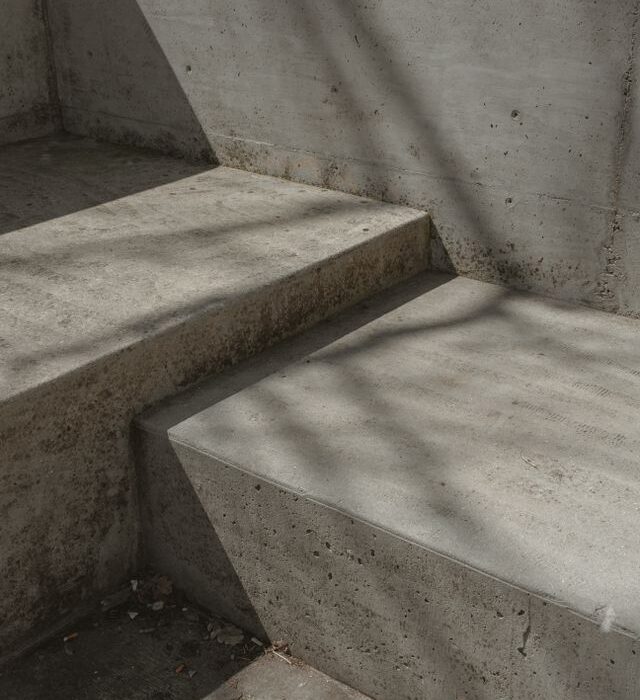
Our summers produce strong shadows that move dramatically across driveways during the day. Architect-designed projects often use that to their advantage. Long clean edges, simple finishes and carefully positioned walls create shadows that become part of the overall design.
It’s something you don’t really notice until you’ve worked on enough of these homes.
Then you start seeing it everywhere.
Another thing we’ve learnt is that drainage becomes almost invisible on well-designed projects.
Water still needs somewhere to go.
It always will.
But instead of obvious falls and awkward grates sitting in the middle of the driveway, everything has usually been planned so runoff disappears naturally without interrupting the appearance.
That’s much harder to achieve than most people realise.
Good drainage rarely gets compliments.
Bad drainage gets noticed immediately.
Most people think premium architecture demands premium complexity.
We’d argue the opposite.
Some of the most impressive homes we’ve worked on have used only one concrete finish across the entire property. The driveway, pathways and entertaining areas all shared the same material, creating a calm, consistent look.
No unnecessary borders.
No random patterns.
Just confidence.
That takes discipline.
Almost every callback we’ve had involving architect-designed projects wasn’t about appearance.
It was about precision.
A joint a few centimetres out.
An edge that didn’t perfectly match adjoining paving.
A level that needed adjusting before the pour.
When the design is clean, every small detail becomes more noticeable.
There’s nowhere to hide.
That means preparation becomes even more important.
We’ve also noticed that homeowners sometimes worry these projects will be difficult to live with.
Too delicate.
Too precious.
The reality is quite different.
A well-designed driveway still has to handle cars, weather, bicycles, bins and everyday life. It just does it with a bit more thought behind the layout and detailing.
Good design isn’t fragile.
It’s practical.
If anything, the planning usually makes the space easier to use.
After two decades working with homeowners, builders and architects across Adelaide, one thing stands out.
The best architect-designed concrete doesn’t announce itself.
Visitors don’t walk in saying, “What amazing concrete.”
They simply feel that the whole property works.
The driveway leads naturally to the front door.
The patio feels connected to the house.
The paths make sense.
Everything appears effortless.
Of course, none of it happened by accident.
It came from dozens of careful decisions made before the concrete was ever poured.
That’s what architect-designed concrete really is.
Not a fancy finish.
Not an expensive trend.
Just thoughtful planning, precise workmanship and the confidence to let good design speak quietly instead of loudly.
Years later, that’s usually the work people still admire.
